In this article
Vocabulary, biology definitions, literary devices, chemistry formulas, dates and verses — a large part of what we study has to be memorised. And memorising, without the right method, means reading and reading and forgetting again.
The Leitner box is an old, simple answer to exactly that problem. Sebastian Leitner, a German journalist, introduced it in the 1970s, and since then millions of people have learned languages with it. In Iran it is hugely popular for English and the Konkur. The idea: see the cards you know less often, and the cards you do not know more often.
What does the box look like?
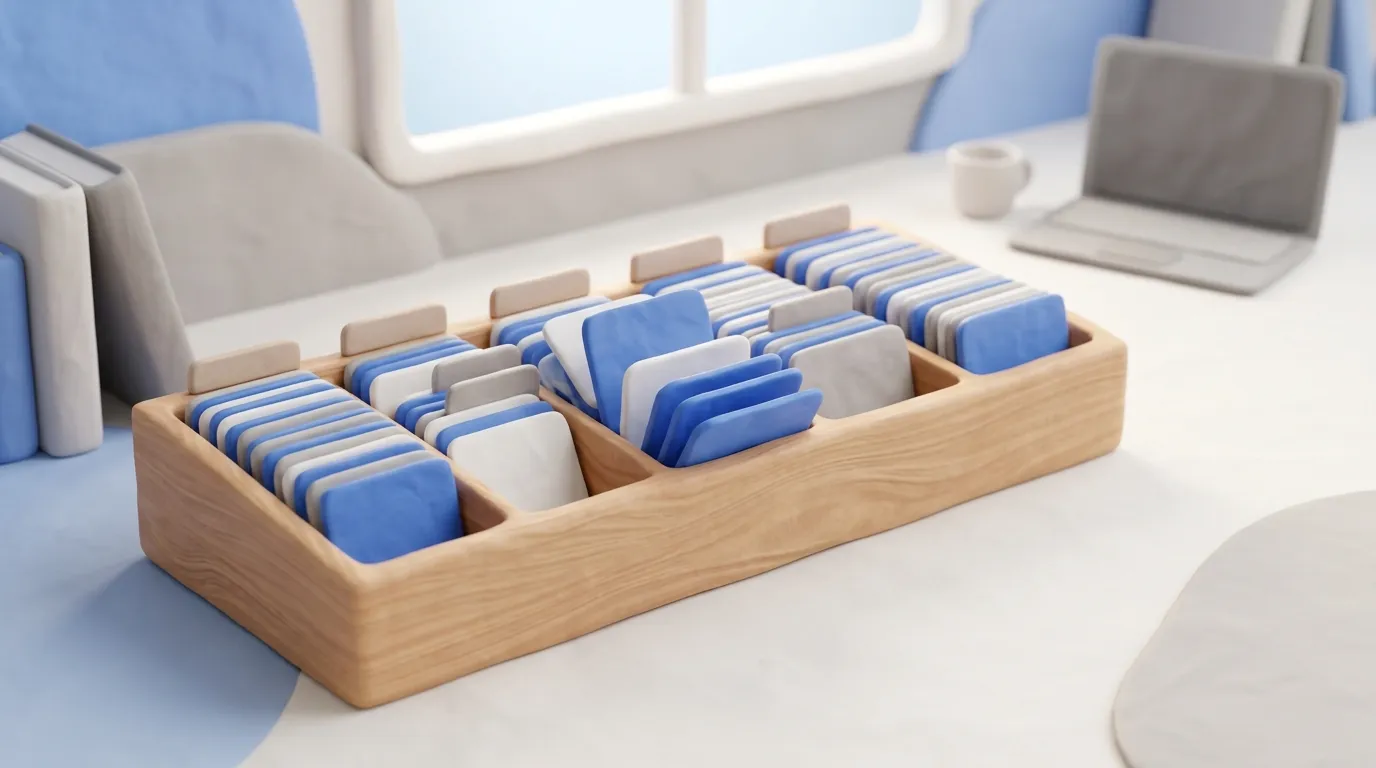
A box with five compartments, each larger than the last. Each compartment means "how often you see this card":
| Compartment | When its cards are reviewed |
|---|---|
| 1 | Every day |
| 2 | Every two days |
| 3 | Every four days |
| 4 | Every eight days |
| 5 | Every two weeks; after that the card is "learned" |
You can change the intervals a little; the principle is that each compartment has roughly twice the gap of the one before.
How the cards move
Every new card starts in compartment 1. Each time you review a card:
- If you answer correctly, the card moves forward one compartment.
- If you answer wrongly, the card goes back to compartment 1, wherever it was.
That simple rule sends your time to the hardest cards on its own. The cards you know gradually move to the far compartments and you see them less; the cards you keep getting wrong stay in the first compartments until you learn them. Behind the rule is the same idea as spaced repetition.
What makes a good card?
The quality of the cards matters as much as the method itself:
- One card, one point. A card with ten lines on the back is not a card; it is a set of notes. If the point is big, make several cards.
- Write a real question. Instead of "photosynthesis", write "in which part of the cell does photosynthesis take place?". A specific question needs a specific answer.
- Write them yourself. Ready-made cards save time, but writing the card is part of learning.
- Add an example. For a vocabulary word, a short sentence using it helps far more than the bare meaning.
A daily Leitner session
- First take out the cards from the compartments that are due today.
- For each card: read the question, say or write the answer, then turn the card over.
- Right: forward. Wrong: back to compartment 1.
- At the end, add a few new cards to compartment 1.
Do not add more than ten to fifteen new cards a day; otherwise in a few days compartment 1 gets so crowded that reviewing it becomes exhausting. Ten minutes to half an hour a day is enough — as long as it is every day.
Which subjects suit the Leitner box?
Anything whose answer is short and specific: words and terms, definitions, formulas, dates, test tips, even the mistakes you keep making in tests. It does not suit long maths and physics problems; there, solving a few key problems again works better. For the test questions you get wrong, keep a mistakes notebook alongside the box.
If you missed a few days of review
A trip, an illness or an exam week — sometimes you do not touch the box for a few days, and when you come back a lot of cards are waiting. Do not review them all at once. First compartments 1 and 2, the rest the next day. Do not add new cards in those few days either, so the box gets back into its rhythm.
Paper or digital?
A paper box is cheap, and writing by hand helps memory. A digital version keeps track of the compartments and review times by itself, no card gets lost, and it is always with you. Whichever you choose, what matters is going to it every day.
In Student OS
Flashcards run exactly this logic for you: you make decks (say "English vocabulary" or "biology definitions"), add cards, and every day the review shows only the cards that are due today. You say the answer in your head, turn the card and say how easily it came to you; an easy card comes back later and a hard one sooner. No compartments to keep track of. Guide: flashcards.
Summary
- Five compartments, each with roughly twice the gap of the one before.
- Right: one compartment forward; wrong: back to compartment 1.
- One card, one point, with a specific question, in your own hand.
- Do not count "almost right" as right.
- Every day, even if only for ten minutes.