In this article
Most students take notes in class, but few think about what the notes are for. If the aim is only to record what the lecturer says, a voice recorder does that too. Good notes are a tool for two jobs: understanding in the moment, and reviewing later. Notes built for those two jobs look very different from a plain transcript.
Copying everything down: the common mistake
When you write down everything the lecturer says word for word, your mind is busy writing, not thinking. The hand writes and the mind does not listen. The result is complete but lifeless notes, and reading them later is like reading the textbook from the start. Studies of note-taking have found that students who summarise the lecturer in their own words learn better than those who copy everything down — because summarising means thinking.
The Cornell method
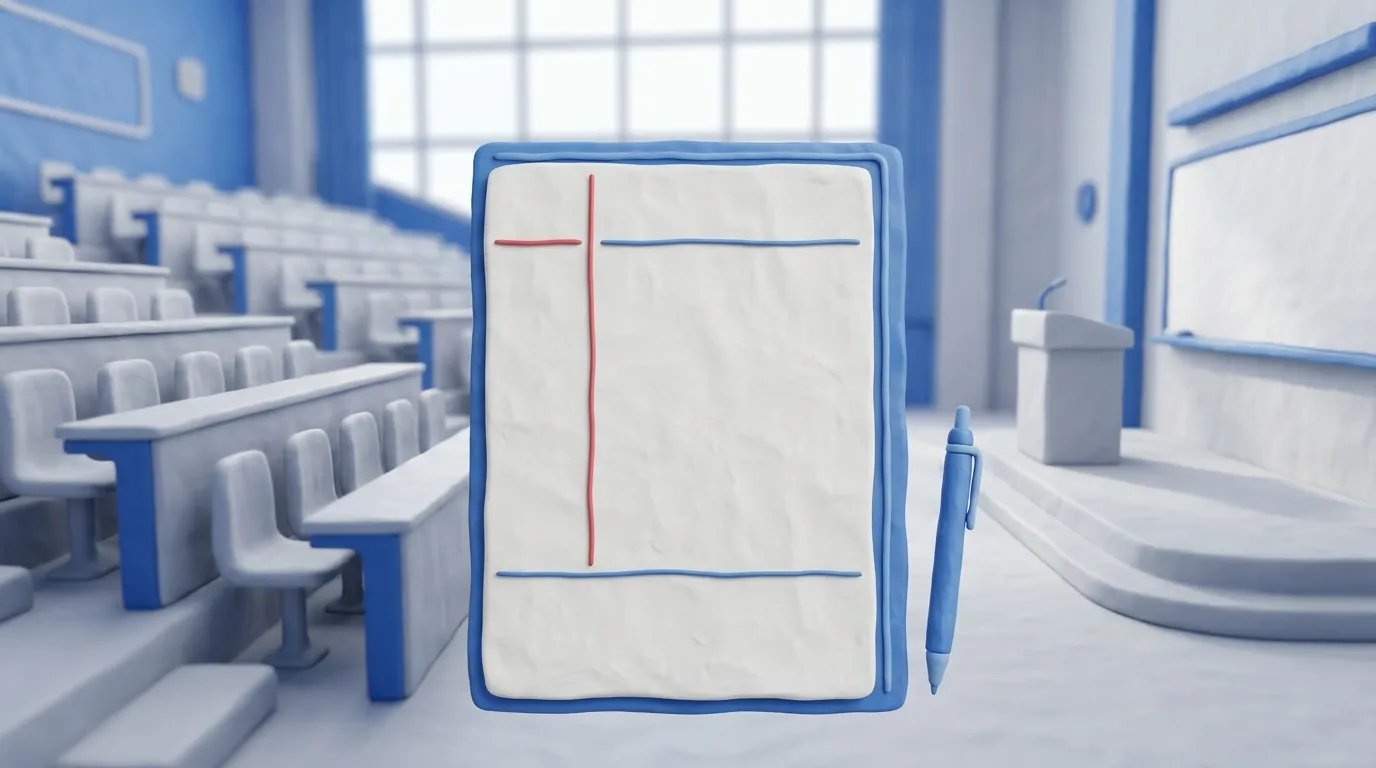
The Cornell method was designed decades ago by Walter Pauk, a professor at Cornell University, and it is still one of the simplest and most effective. Divide each page into three parts:
| Part | Where on the page | What goes in it |
|---|---|---|
| Notes | The large area to one side | The class's points in your own words |
| Questions and keywords | A narrow column beside the notes | Questions and key words, after class |
| Summary | A few lines at the bottom | The whole page summed up in two or three sentences |
In class you fill in only the notes area: the main ideas, definitions, examples and diagrams. Full sentences are not needed; write briefly, with your own symbols.
After class, ideally the same day, fill in the questions column: for each part of the notes, write a question whose answer is that note. Then, at the bottom of the page, sum up the whole page in two or three sentences.
When you review, cover the notes area and look only at the questions. Try to say the answer from memory. This is the same active recall that turns your notes from something to read into a tool for testing yourself.
What should you write down?
- Anything the lecturer repeats or writes on the board. Those are usually the things that come up in the exam.
- Sentences like "this is important" or "make sure you know this". Put a special mark beside them.
- Examples. You will find the definition in the book, but the example the lecturer gave is often not there.
- Your own questions. Wherever you did not understand, put a question mark so you can ask later or find the answer.
Paper or digital?
Some studies suggest that writing by hand, because it is slower, forces you to summarise and leads to better learning. On the other hand, digital notes are searchable, do not get lost, and can sit next to a photo of the board. There is a middle way: write by hand in class, then type up the main points and questions afterwards. That rewriting is itself a review.
After class: ten minutes that change everything
Most forgetting happens in the first day or two after a class. If you spend ten minutes on your notes the same day — writing the questions column, filling the gaps, writing the summary — what stays with you from the class multiplies. We explain why in spaced repetition.
Other people's notes
A classmate's notes are useful for a session you missed or for filling gaps, but they do not replace your own. Notes you wrote yourself are in your words and your marks, and they are read far faster when you review. If you borrow someone's notes, move their main points into your own notes rather than just keeping a copy.
In Student OS
The questions you draw out of your notes make the best review tool as flashcards: a hard card comes back sooner and an easy one later. Record the topics each session covered in topics, so the review ladder brings them back in time. Guides: flashcards, topics and review.
Summary
- Notes are for understanding and review, not for transcribing.
- Write in your own words; summarising means thinking.
- The Cornell method: notes, a questions column, a summary at the bottom of the page.
- Ten minutes of review and gap-filling the same day.
- When you review, cover the notes and answer the questions.