In this article
Many people study maths like any other subject: they read the lesson, look at the examples, everything seems logical, and they think they have learned it. Then in the exam they see a problem that is a little different from the examples and do not know where to begin.
The reason is simple: understanding someone else's solution is not the same as finding one. When you look at a worked example, every next step is right in front of you. In the exam, you have to find the next step yourself. Maths is a skill, like swimming or riding a bike: it is not learned by watching.
Step 1: understand the idea, not just the formula
Before solving problems, ask where this formula comes from and what it calculates. A formula that has only been memorised is no use when the question is worded a little differently. A few questions that test understanding:
- Can I say in my own words what this formula says?
- If one value doubles, how does the answer change?
- Can I make up a simple example with my own numbers?
If you cannot answer these, go back to the lesson or ask your teacher. Building on an idea you have not understood only falls apart later.
Step 2: read worked examples actively
Do not read a worked example like a story. Read the problem, cover the solution, and try to guess the first step yourself. Then look at the book's first step and compare it with your guess. Repeat for the next steps. It is slower, but it turns every example into a small exercise.
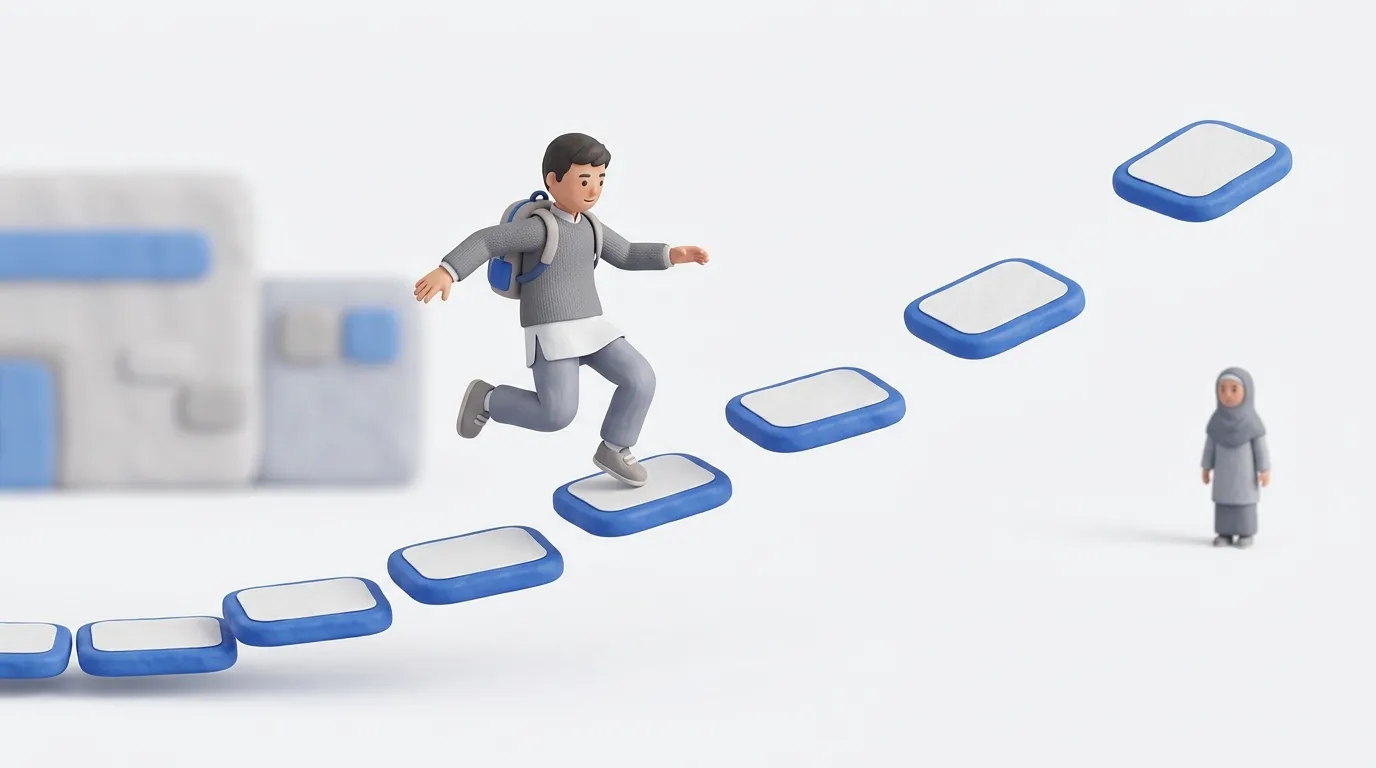
Step 3: drop the help bit by bit
An order that works for most topics:
| Stage | What to solve | Help |
|---|---|---|
| 1 | Worked examples, with the solution covered | The book's solution, for comparison |
| 2 | Exercises like the examples | Only if you are truly stuck |
| 3 | Mixed, different exercises | No help |
| 4 | Exam questions or timed tests | No help, against the clock |
When you get stuck
Getting stuck is part of learning maths, not a sign of failure. When you are stuck:
- Read the problem again. Very often you missed a given value or a word.
- Write down what you have and what you want. That list alone often shows the way.
- Try a simpler case: with smaller numbers or a simpler figure.
- Find a similar example and see what was done there.
- If you are no further after ten to fifteen minutes, look at the solution — but only up to where you were stuck, and carry on from there yourself.
Quality matters more than quantity
Twenty similar problems solved one after another only repeat a single pattern. It is better to solve more varied problems and ask yourself after each one: "What was the key to this problem? Which idea unlocked it?" After a few weeks, a collection of these key ideas builds up in your mind, and a new problem is no longer a stranger.
Take your mistakes seriously
In maths a large share of marks is lost to carelessness: a minus sign, a swapped digit, a unit. Write your mistakes down with their reason so you can find your own pattern; the method is in the mistakes notebook. For written exams, remember too that writing out the steps is part of the mark; the details are in national final exams.
Spread your maths out
It is better to do a little maths every day than a lot once a week. Problem-solving skill is built by regular practice and rusts over long gaps. If you skip maths for three days in a row, on the fourth day your hand feels slow. And do not forget to review earlier topics: every so often, solve a few problems from previous chapters; we explain why in spaced repetition.
In Student OS
In topics, break each maths chapter into its topics and mark your progress and confidence in each; the review ladder brings earlier topics back in time so your maths does not rust. For Konkur students, test practice and the mistakes notebook record every set of maths tests, and focus times your problem-solving sessions. Guides: topics and review, test practice, focus.
Summary
- Maths is learned by solving, not by reading.
- The idea first, then the formula; ask where the formula comes from.
- Read examples with the solution covered, and drop the help bit by bit.
- Stuck? The givens, a simpler case, a similar example; then the solution, only up to where you were stuck.
- Solve a problem you needed help with again, alone, a few days later.